Stop building AI tools. Start hiring AI co-workers.
by Mohit Srivastava
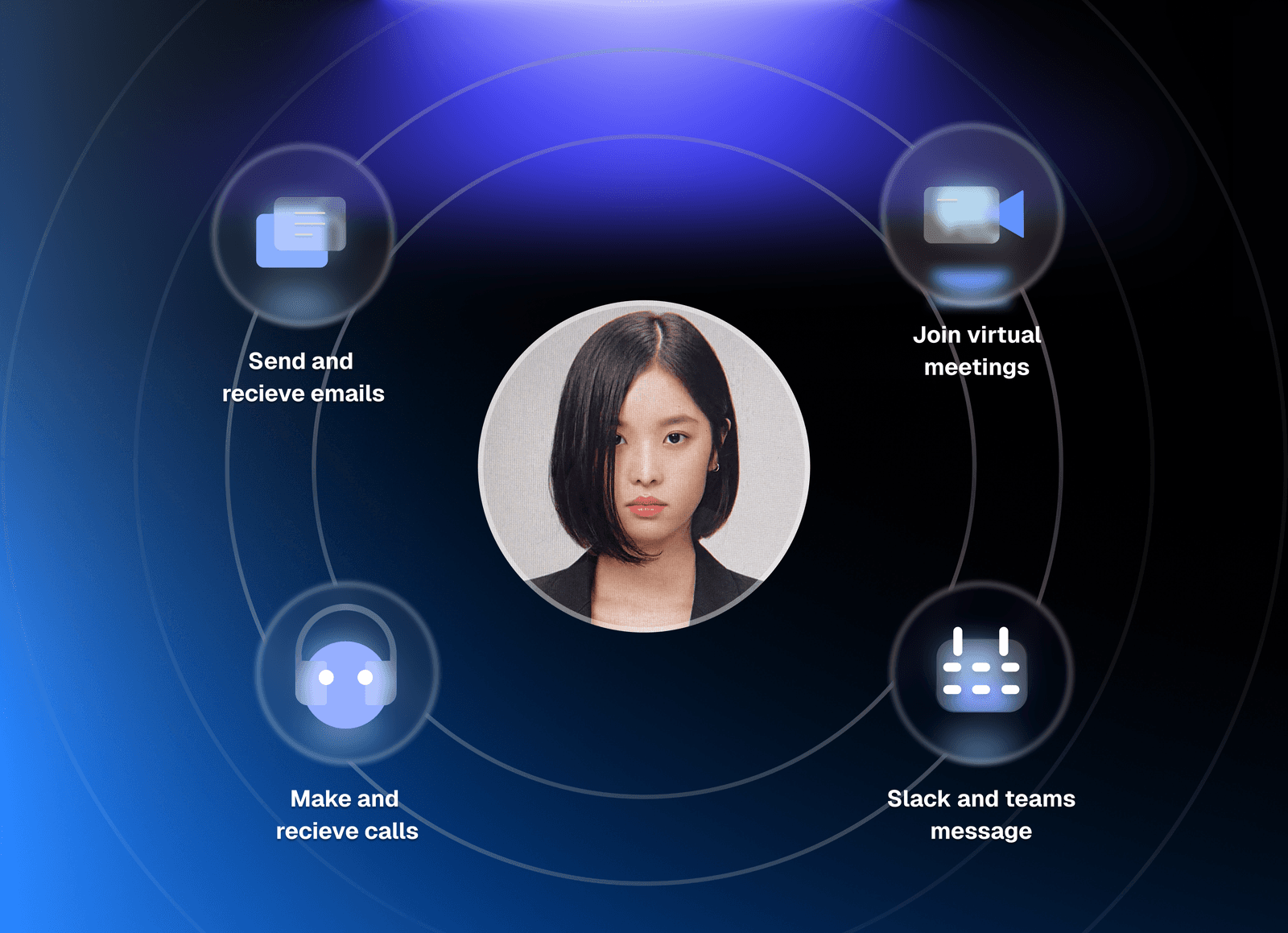
For two years, enterprise AI has meant tools: assistants that draft, summarise, and answer. Useful. Bounded. And, increasingly, not the point. The next phase is different in kind, not degree. Organisations are starting to hire AI co-workers: digital employees that hold a role, own an outcome, and get measured the way a person in that seat would be. That sounds like a marketing tweak. It isn't. It changes how work gets assigned, where accountability sits, and what you actually have to build.
The word "agent" now means everything, which is why it means nothing. Draw the line cleanly:
- A co-worker: the business-facing unit. A name, a defined role, a persona, the channels it works across, memory, and measurable outcomes. It maps to a recognisable human job: a recruiter, a collections officer, a claims specialist. Not to a project or a workflow.
- A skill: the unit of capability that powers it. What many teams call an "agent" today is better understood as one specialised skill the co-worker draws on.
That gives you a clean architecture: Tools to Skills to Co-workers. Tools take atomic actions. Skills package reusable procedures and domain expertise. Co-workers compose skills to do a real job. The business stops talking about prompts and workflows and starts talking about roles, outcomes, and KPIs. It is the only language the rest of the organisation actually speaks.
Enthusiasm has outrun production. A large share of agentic AI initiatives are expected to be cancelled in the next couple of years. The reasons rhyme every time:
- Escalating cost
- Unclear business value
- Inadequate risk controls
The fix isn't to slow down. It's to design against all three from day one. Control cost with reuse: a library of skills and archetypes, not bespoke one-offs. Make value concrete by tying each co-worker to a role and a measurable result. And treat governance as part of the platform, not a bolt-on.
Here's the uncomfortable truth: the models are already good enough for a growing set of real jobs. What's missing is trust. Can a risk officer approve it? Can an auditor reconstruct what happened? Can it be changed safely?
The organisations that win the next phase won't be the ones with access to the best model. They'll be the ones who learned, earlier and more rigorously, how to build digital employees their own risk officers, auditors, and customers actually trust.
That means a governance layer that sits across every co-worker: guardrails on inputs, tool calls, and outputs; a shared human-in-the-loop path with clear escalation; validation of the work produced; and an immutable, replayable record of who decided what, when, and why.
And it means earning autonomy, not granting it. A co-worker starts supervised, graduates to monitored, and only then to delegated, once accuracy, escalation rate, and user confidence clear explicit bars. Every promotion is a business decision, not a software release.
Stop thinking prompts, workflows, and agents. Start thinking roles, skills, channels, outcomes, and KPIs.
The companies that internalize that, and build the trust layer to back it, won't just adopt AI faster. They'll run a workforce their competitors can't copy, because it's earned, not bought.